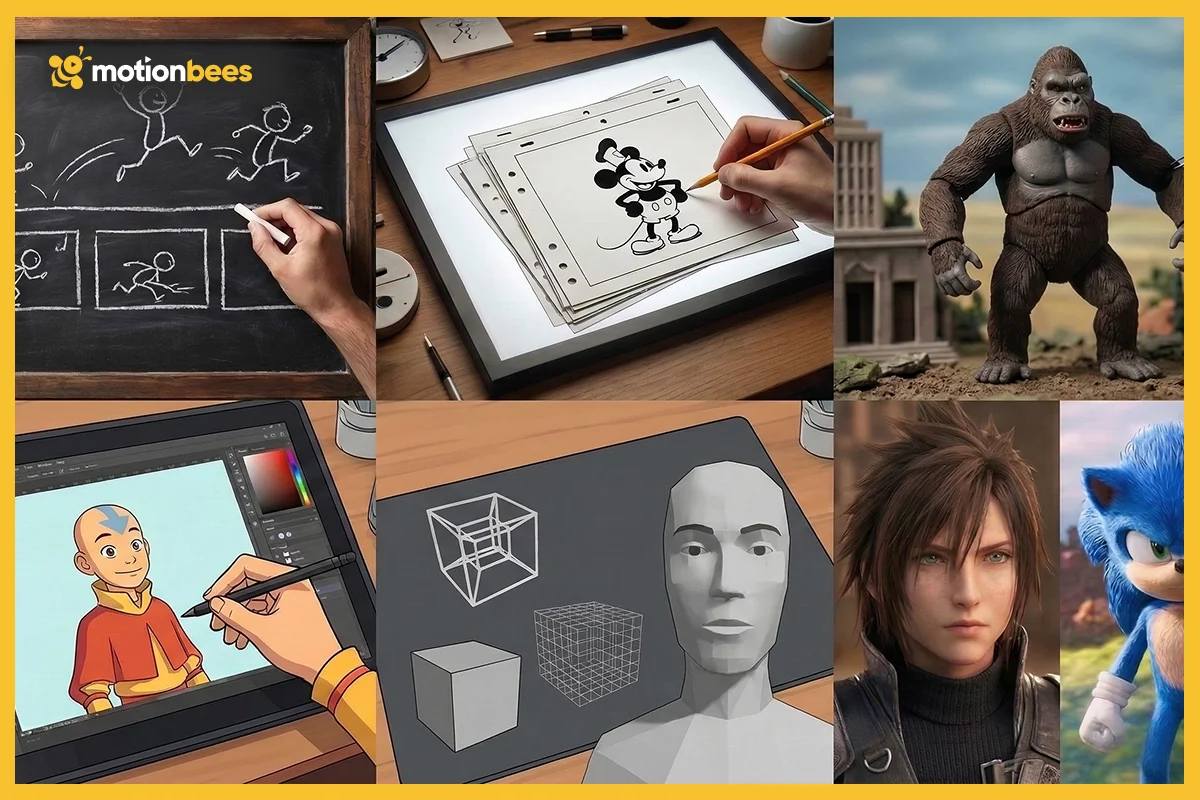
- The Early Development of Animation (Before 1900s)
- Traditional Animation (From 1900s to 1920s)
- The Golden Age of Animation (From 1930s to 1950s)
- The Television Animation Boom (From 1960s to 1980s)
- The New Age of 3D and Motion Capture (From 2000s to 2010s)
- Animation in Social Media Age (From 2020s to Now)
- The Rise Of 3D and Visual Reality
- Effects of Evolution of Animation on Industries
- The Future of Animation
- Conclusion
Animation is not just another cartoon on the screen; it is the revolution of storytelling. It all started with basic drawings in 1800s and look at animation now. Everything is digital, feels more real and exciting. This explains the evolution of animation that has helped entertain, educate, and communicate audiences.
To understand the evolution of animation, you first need to find answers of the following questions. For example, how has animation changed over the years, and when did animation become popular.
Animation dates back to hundreds of years and in this blog, we are going to talk about the history of animation timeline. We will discuss how it has evolved as motion graphics services that a lot of animation companies offer.
We will also step by step discuss when and how was the word animation came into existence.
This guide also explains how technology, culture, imagination, and storytelling remained useful in every era, even now.
The Early Development of Animation (Before 1900s)
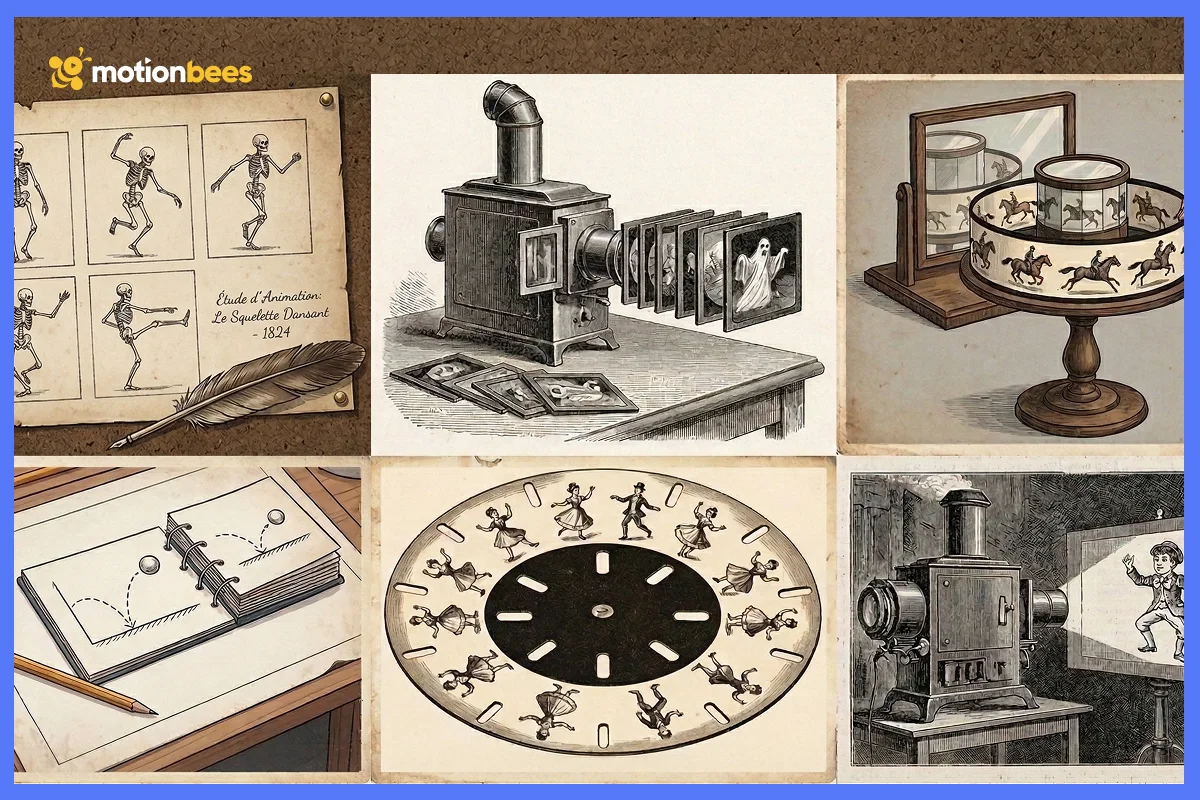
Human beings took interest in movement long before the invention of cinema or computer. Think about a drawing in which there is a cave from the prehistoric world. The animals in that drawing has more than 2 legs and each leg had a different shape. It was not ornament; it was an idea to experiment and trying to portray movement. This leaves people wondering, what is the evolution of animation? Spiritually, thousands of years; practically, the history of organized animation dates back in the 1800s.
Early Motion Devices

Inventors experimented to create a method of deceiving the eye to move. Persistence of vision is our brain making fluid motion of flashing images. This was the basis of the Zoetrope and Phenakistoscope which was invented in the 1830s. These devices turned around and people could see drawings come alive. It was a little yet a mighty step towards animation history.
From Toys to Public Shows
In the early years of animation, the ideas were improved. In 1877, Emile Reynaud introduced an animation device called Praxinoscope that could show 12 frames at a time. This way, animators at the time were able to create fast and smoother motion.
In 1892, he showed projections of hand-painted animation to the audience. This was one of the first cinematic experiences of animation.
Audience loved it already but they wanted more and these early experiments delivered storytelling through motion pictures.
The First Animation Ever
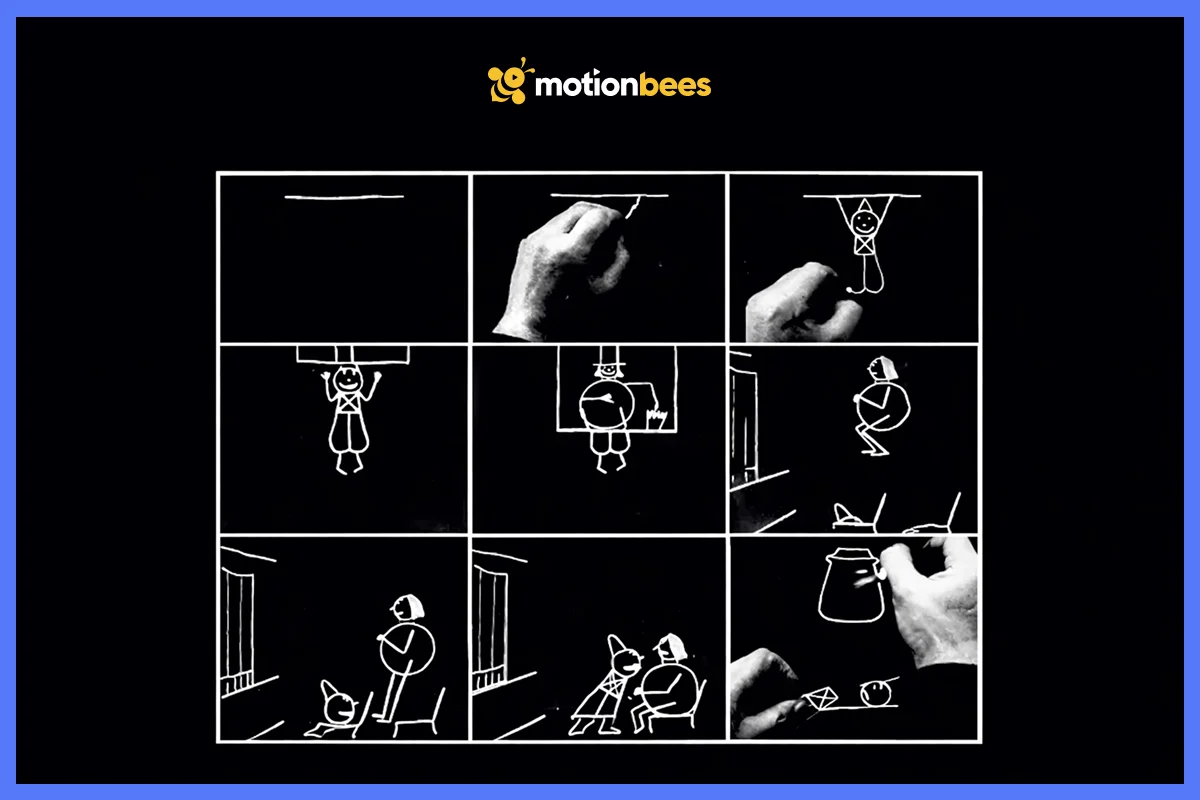
The first animation was not digital, colored or refined. It was basic, felt like magic and experimental. At that time, the maker wanted to deliver an illusion to make images felt real.
Imagine how people from 1892 felt looking at a moving drawing on the wall, they must have felt wondered. It is just like how we feel when we see 3D animated video on a billboard.
The initial period was the foundation and then after came after that. Nowadays, the same techniques apply in most of companies. Images are made frame by frame to deliver a story and then motion is added by a lot of video animation companies.
Why It Matters Today?
These were the inventions which led to the timeline of animation history. They proved that movement has the ability to convey concepts, narrate, and entertain. This idea shaped modern animation which is why we see more creativity and technical use in animation today.
All this explains how evolution of animation happened and the purpose behind it.
Traditional Animation (From 1900s to 1920s)
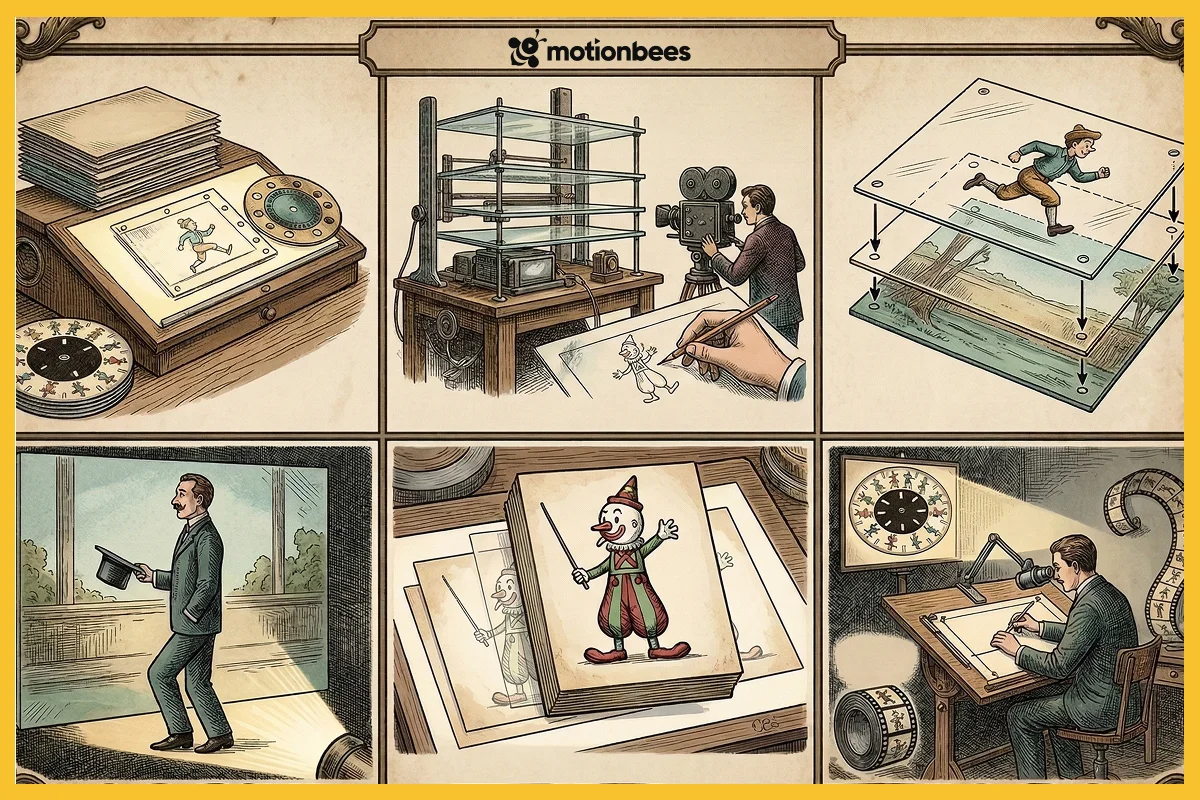
To better understand this era, imagine yourself sitting in a theater in 1900s, hearing sharp sounds like scratching and seeing the hand-made pictures moving. This was the origin of animation history, started with the Humorous Phases of Funny Faces by J. Stuart Blackton.
The idea was to make stories frame by frame and then photographed them. If you are studying animation now, you will regard as the simple animation technique.
This idea was revolutionary because it ignites this one questions in our head, which is whether moving images can narrate a story or not.
Who Invented Animation?
The first animation or say hand written cartoon was Fantasmagorie by Emile Cohl. The cartoon has flowing movements so we can’t really regard it as the animation but yes that’s when evolution of animation started.
One of the first character animation was Gertie the Dinosaur in 1914 by Winsor McCay. The character Gertie had a personality and he was responding to the commands of the animator in live-time performances.
This era reflects that animation can entertain and surprise the audience.
Crafting Stories by Hand
It took artists thousands of frames back and forth to draw frames to span a few minutes of film. To make each second of such films, animators used to make 12 to 24 drawings. It was a labor intensive process but was also the foundation of evolution of animation timeline.
From this, you can easily track how long has animation been around. Initially, it was about having a storyline, emotions and imagination and it did really amaze people because they had seen nothing like that before.
Today, when one look for inspirations, they study traditional animation period and their techniques.
The Golden Age of Animation (From 1930s to 1950s)

Back then, animation was just an idea which became a reality in 1930s. In 1937, people used to enjoy animated movies like Snow White with their families. It was a source of entertainment during celebrations which caught hearts and even do now.
This era told us when does animation become popular and that it could have feelings attached to it.
The First Feature Films

In 1928, Steamboat Willie was the first sound of a cartoon character. And then, Mickey Mouse which is loved by everyone. Even now, kids still want and watch those characters lovingly.
At that time, large studios like MGM and Warner Bros found a way to feed those kids with their favorite cartoon movement. They created shorts as pre-movie entertainment and cultural influence. This period explains that the purpose of animation is to amuse people, and to experiment with technique, music, and narrative.
Animation as Cultural Icon
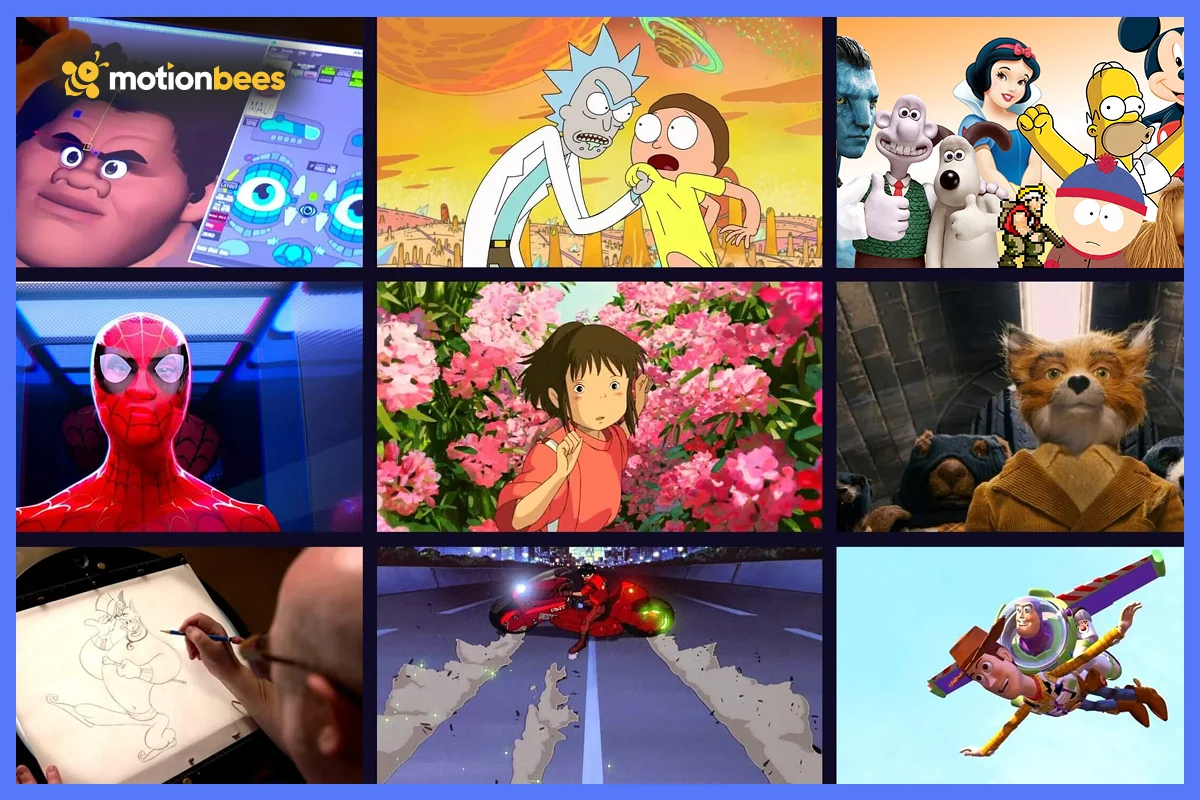
In 1940s and 1950s, animation was all over in cinema houses. Movies were making millions of dollars and actors were as famous as their characters. It is also the time when animation made its way in marketing and merchandising to build early roots of brand storytelling.
The Television Animation Boom (From 1960s to 1980s)
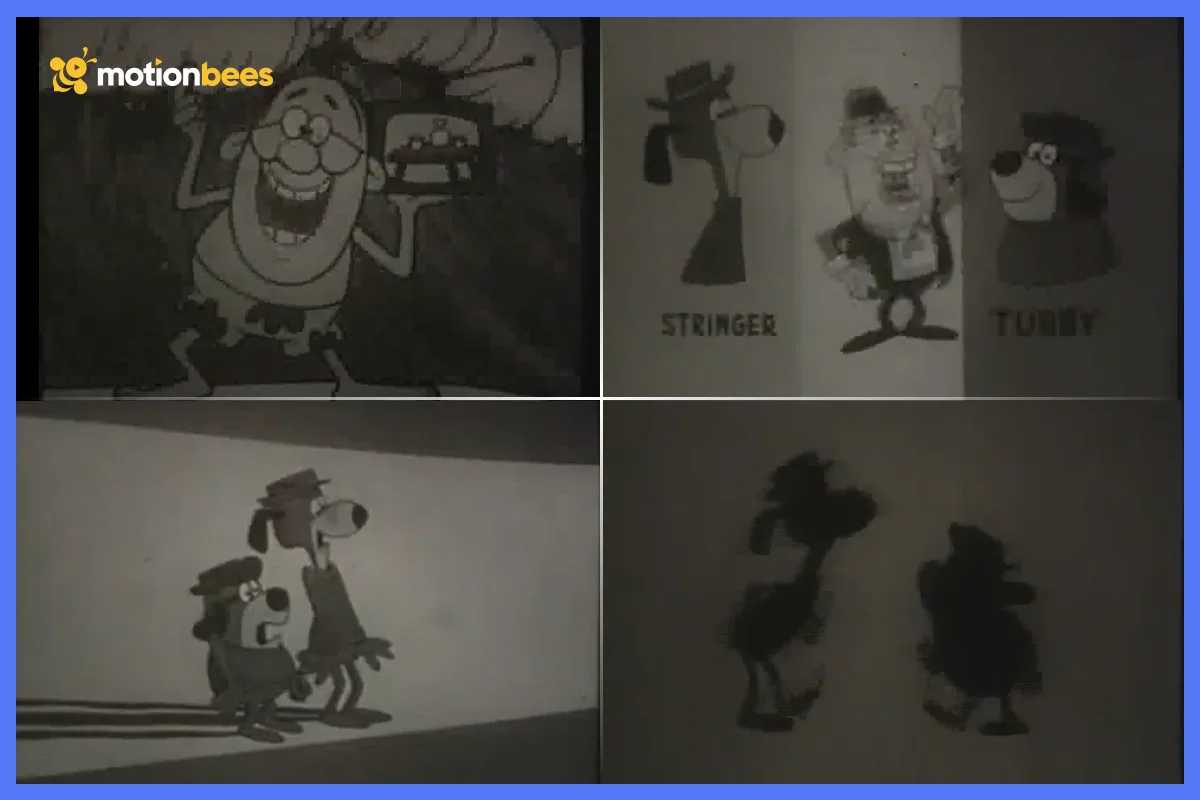
The 1960s have brought animation to the living room. The studios had fewer resources, shorter deadlines and tighter budgets resulting in limited animation. But the people wanted more and more. Every Saturday, they would stick to the screens wanting more motion.
In those times, animators used a trick where they moved characters a bit and reused backgrounds. This worked because the narration was still solid.
Making Cartoons Accessible

The first cartoons or film made accessible and became a part of everyday life was ‘The Flintstones’ and ‘The Jetsons’ by an American animation studio Hanna Barbera. They made use of cost effective and limited animation techniques that streamlined for 4 years on every Saturday morning.
It teaches us how animation evolved over the decades and that it was this era when evolution of animation was evident in both theatrical shorts and simple TV shows.
Everyone loved and enjoyed it because it was accessible to all, not forgetting that it was still evolving.
Storytelling and Global Influence

Meanwhile, Japanese anime was making its way. Astro boy presented the world with another visual language. It focused on story and emotion despite having less frames. It proves that the animation has existed in the world long before and how it was creative even within limits.
This explained that animation can be a great source of storytelling. It is a communication language employing different culture, design, and marketing strategies.
The Digital Revolution (1990s)

At the end of 1900s, animation finally evolved as CGI or computer generated images found its way. If you would talk to someone from 1995, they will tell you how Toy Story was the breakthrough. All its characters are digitally generated.
And then, it was not just cartoons but fully fledge film that impressed everyone with digital techniques. Shows were not only appealing and sharper to look at, but also engaged and touched with storytelling.
The First Fully CGI Feature

In this period, 2D and 3D animation started to merge. Animator were experimenting with lighting, textures and depth which was with hand-drawn frames. It was also during this time that animation was more accessible and brands started approaching for storyboard design, motion graphics services and infographic design services
A Combination of Traditional and Digital Techniques

Initially, people used hands to make drawings but it was hundreds and thousands of them. This was not easy to do. Then, people started mixing old and new techniques to bring more effects and depth. For examples, drawing hand using hands but then adding shadows, movement and effects using digital tools.
A lot of animation companies back then took this idea and started using it in films and commercials.
The New Age of 3D and Motion Capture (From 2000s to 2010s)
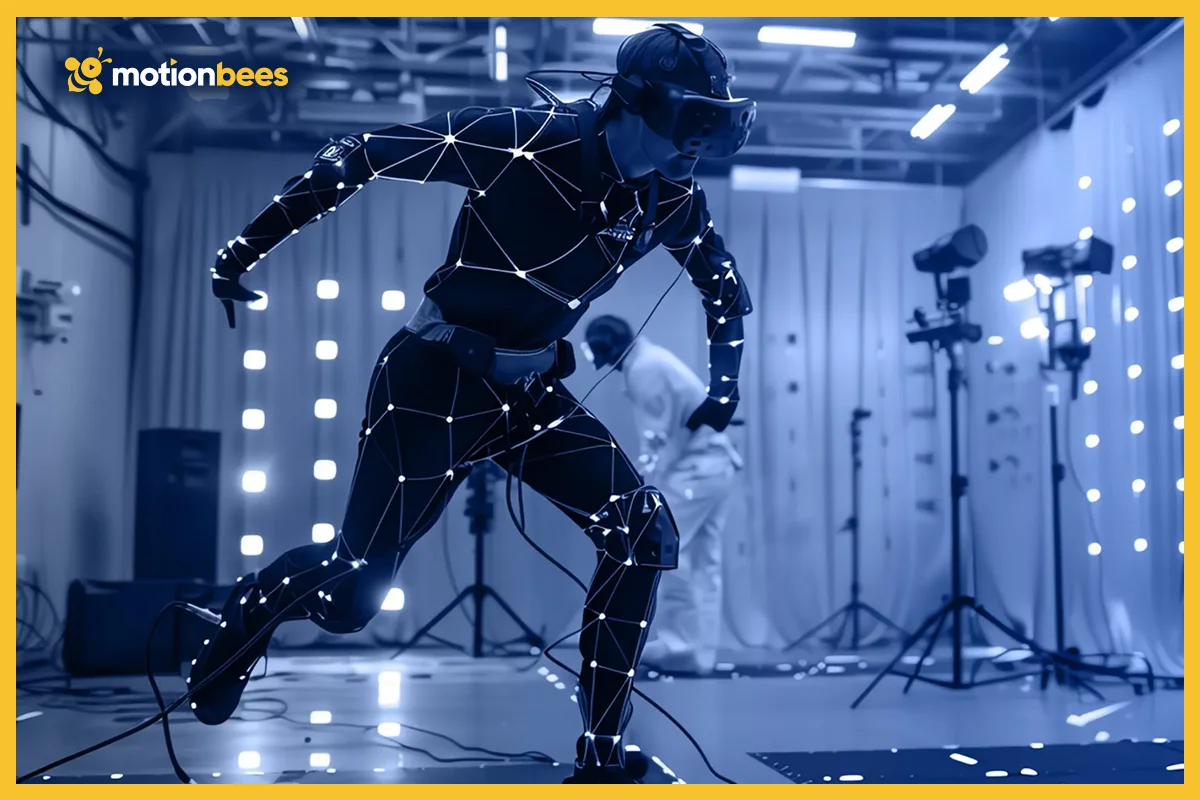
In 2000s, animation was closer to the reality. By then, animation was evolved a lot. Using motions, it was easy to mimic actors’ motions into digital characters to make it look like real performances.
Motion Capture Milestones

Have you seen ‘The Lord of the Rings’? the Two Towers in them were virtual environments made with animation. They used miniatures and digital models to do so. The film itself achieved a technical achievement award because of the wonderful animation.
Also, the Avatar released in 2009 is another great example in which you can see custom and AI characters. Everything, from motion to voice and characters were animated. This kind of animation was a mix of Japanese anime and American cartoon styles and it made more than 2.9 billion dollars throughout the world.
Video games followed in the footsteps and characters became human and realistic. This is how old is animation and it can be seen that it has a history more than 100 years old but it is constantly changing.
Animation in Entertainment and Beyond
Animation is not limited. Now, people from different industries make use of it, be it films, games and marketing material. This is why we have professional video animation firms providing motion and infographic design services to different industries.
This explains that animation is not only for entertainment purpose. You can use it to simplify educational concepts and celebrate social campaigns.
Animation in Social Media Age (From 2020s to Now)
You will now find animations everywhere around you.
Now, not only animators know how to create one but people with science or commerce degrees too. This is the power of education; you can teach yourself anything you want.
Imagine a small firm that described a complex application within 30 seconds using an animated instruction. This is how motion simplifies everything and help people understand ideas or hook audience.
The Evolution of Animation Styles
Animation has not remained the same. The look and the feel of the stories on screen is changing with every decade. From the first ever cartoon to animations nowadays, animation advanced with new culture, creativity and audience expectations.
The Playful Beginnings
The early years were characterized by rubber hose animation in 1920s and 1930s. Characters were bendy, bouncy and with expressive faces. The aim was to add exaggeration into characters and their movements.
An ideal case is Steamboat Willie in which the movements were elastic and rhythmic. At that time physics didn’t matter, entertainment did. It was magic to see the characters elongate and recoil into shape.
This era focused on energy which is why they made animations in which the characters were behaving the way one can’t possibly imagine.
It is also how characters, their personality and timing started to play an important role in animation and still do.
Emotional Richness and Culture
As the animation evolved, the storytelling became more elaborate. Japanese anime took the emotional expression to a new level. The motions were calmer than chaos. They made use of facial detail and cinematic framing to produce moments of strength.
The movies such as Spirited Away proved the way animation could become poetic and human. The smallest motions had meaning. They added more details to the background to make it fulfilling which emotion took center stage.
This kind of transition took hearts. It showed how simple or slight movements can amuse people. They played around characters and story and focused on art more than entertainment.
The Rise Of 3D and Visual Reality
Digital revolution brought 3D animation and it altered the way characters would move and interact with their environment. It was useful because it added more depth, lighting, and texture.
The first computer-animated film, Toy Story, was one of the greatest accomplishments. It demonstrated that digital characters had the capacity to carry the feelings and at the same time fit in the real world.
With 3D animation, the camera angles were dynamic, and the movement was realistic. It increased the possibilities of storytelling and brought animation into a new creative field.
Fusion of Styles for a New Generation
Technology increased and producers started blending methods rather than selecting one. Old fashioned 2D textures mixed with 3D surroundings and comic style frames lay over on the digital depth.
The first film to feature some experimental techniques was Spider-Man, which was released in 2018. The film was a combination of comic-book and CGI, and it brought a fresh exciting appearance. It didn’t chase realism. It celebrated style.
This was a time when evolution of animation was not necessarily about more refined graphics. It’s about creative risk. Viewers react to novelty than quality.
The Minimalism in Digital Era
Cinema is experimenting with visual but the digital marketing wants to be minimal. They are going towards simple and clean visuals to deliver ideas.
Nobody wants to confuse their audience on social platforms which is why, you can see simple motion graphic trend.
Now, straight lines, vibrant colors and smooth edges help convey messages faster.
To better understand, look at the brand product launch of Apple Inc. They have used light, smooth and clean animation design to look professional and attract attention.
This explains evolution in animation and that change occurs considering the viewer habits.
Now we know that people scroll fast which is why animation is more about making things clear than complex.
What Does Evolution of Animation Simply Tells?
Looking at these examples, one thing becomes very clear. Animation has to develop, as the audience develops. In each era, you can see that animation evolved to fulfil audience needs. If they wanted a playful, historic, emotions, or real feel, animation was built around it.
This explains that animation never really followed technology, it followed culture and still do.
Animate your brand by choosing animation that fits your culture
Effects of Evolution of Animation on Industries

Animation is no longer limited to cartoons or cinema. You can see it everywhere around you in every industry which explains the evolving nature of it.
Now, brands are telling stories, their messages and ideas differently. Animation which was a basic handmade drawing is now digitalized. It has become an important tool for entertainment, marketing, and educational industries.
Animation in Film and Gaming
Years before, animation examples were only films and cartoons. Nowadays, use of animation is everywhere. This is because of new trends, devices and ideas that people are experimenting with.
Brands now use 3D animation instead of 2D to provide depth and more visual effects. If you see closely, almost everything around us is animated that too with the help of digital tools.
Filmmaker are making use of animation to deliver a scene that a human naturally can’t do. The examples are everywhere around us, like Stranger Things and Marvels.
The gaming industry goes even further. They are using interactive characters, and dynamic environments to hook the audience. According to Newzoo, the worldwide gaming market is worth more than 184 billion in 2023, and animated design is at the center of this development.
Today, the modern gaming is dull and dead without animation. To engage players on an emotional level, it is important to add movement.
Animation in Advertising and Marketing
Do you ever wonder how some advertisement sticks to our minds. Well, it is the magic of animation used in them. Today, when the competition is increasing day by day, brands have switched towards motion images.
These are not only easy and fun to watch but memorable. According to HubSpot, video content has a high conversion rate (about 86%), longer lifespan, and it can easily be shared. That is because motion typically catches attention longer than a piece of text does.
Animation was never meant to impress; it was meant to entertain and then engage. This means, you can’t add animations to your platform to add beauty. You can use it engage audience, retain them and build a unique brand identity.
You can use animation in your marketing and branding. Whether you have a product to display or want to build brand identity, animation works best for advertising and marketing.
Animation in Teaching and Learning
It’s not like ancient times when people have to read and memorize every word or take classes to understand. Today, you can find everything on the internet. It’s not just comfort but the way knowledge is given there.
It is because of animation that abstract subjects like science, technology and business are easy to master.
There is no need to memorize definition when animated videos can help you learn concepts better.
If you want to educate without boring or distracting your students, you can use animations to make topics easy.
Keeping in mind that the attention span is reducing day by day, animation helps here by keeping people informed without losing them.
A Modern Purpose
Animation used to entertain the audience and now it is informing, influencing, educating, and acting as a bridge in industries.
This change is due to increasing need of audience to want more which is why, animation is now strategized. Brands can use animations in digital marketing campaigns. It can strength brand identity, user experience and communication.
Whether you are from gaming or education industry, animation can fit any field and fulfil audience needs.
Animation is created at its most fundamental core to bring ideas to life. And in a world that focuses on images and has a short attention span, that capacity makes it more topical than ever.
Technology and User Experience in Animation
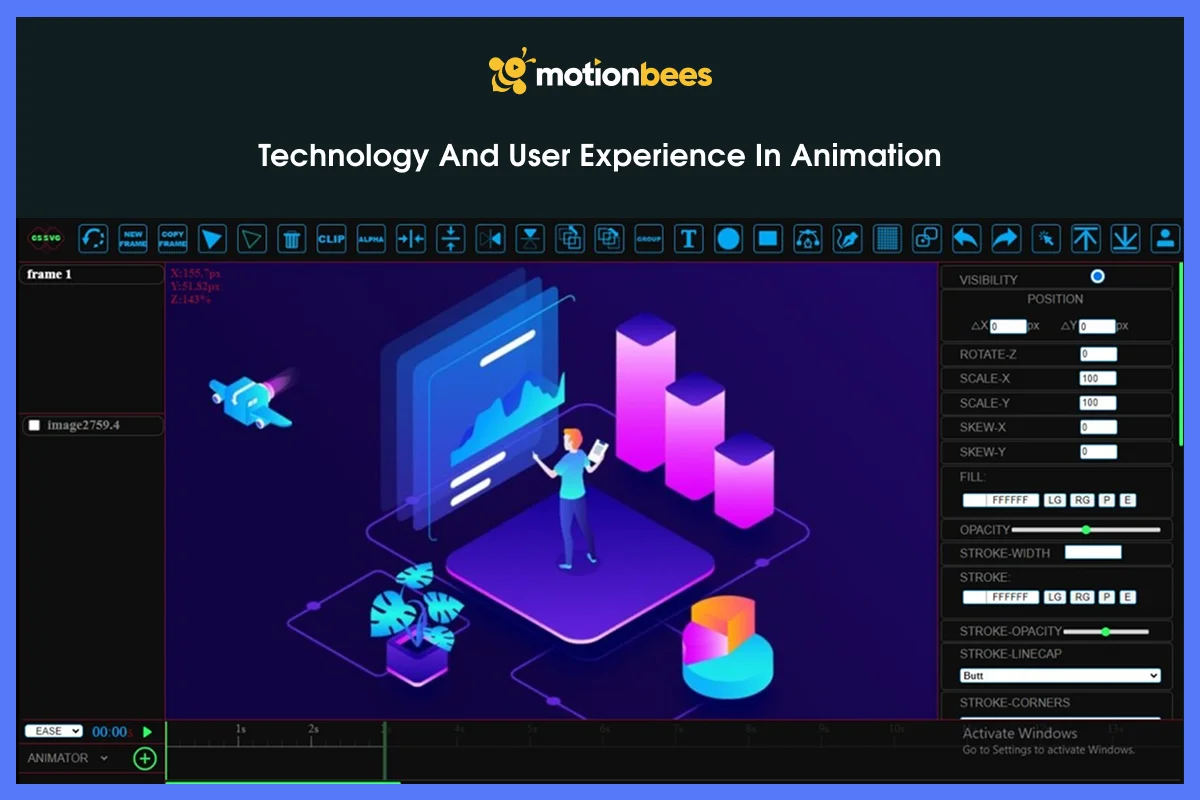
Other than entertainment and marketing, animation also has a strong impact on technology. For example, you’re on a website and you click a add to cart button which directs you to a new page. This seamless transition is tiny but has a purpose.
Just like these, micro interactions can be used in apps and websites to attract users. More than attraction, it will serve a purpose to secure and direct users. The best part is that these animated micro interactions also ease user navigation.
With animation, it is possible to make flexible interfaces. These will never overload but direct users to the spot. This enhances usability and makes design appealing to the eye.
This explains why animation works wonderfully for tech companies. It makes users respond which brings feedback. And it is feedback that builds confidence. This kind of interaction directly contributes to retention and growth.
The Future of Animation

As we have discussed the evolution of animation, it is clear that animation is not going to stop evolving. With more people starting to use and experiment, it is evolving and will evolve in the recent times.
The best thing happened to animation was AI. Making animation is not an easy process, it needs idea, story and technical movements. AI has helped made this easy by generating backgrounds, doing lip-syncing, and adding realistic motions.
It is like a combination of real and fake world making peace with each other. Filmmakers and animators now use AI to experiments scenes that heroes can’t do, like flying over bridges during a fight.
As the world is evolving and we come across now tools and devices, people starting to experiment. Today, the idea is to connect the real world to virtual world also known as Metaverse. It is to create and relive memorable experiences.
Animation is still evolving. If you are brand looking to experiments with the new tools, now is the time.
Conclusion
Animation has grown from hand written images to completely digitalized, 3D, and immersive motion videos. The evolution of animation can be seen everywhere, from movies to video games. It is true that the animation has transformed in every age, starting from basic movie to CGI ones. One thing remained the same and that was creativity which has kept us with culture and technology even now.
It is a great communication tool which can deliver ideas, imagination, and emotions. Animation brings people together in a way that no other medium can do. This proves that creativity has no expiry date which is why animation will keep on evolving along with the world.
The history of animation started centuries back. The idea was to put motion into art. It started with frame by frame images which was played altogether to depict motion. This was before 1900s when the tools like Zoetrope and Praxinoscope were used to form the basis of the first animation ever.
The first movie was hand-made, created by Emile Cohl (1908). The movie is called Fantasmagorie. And then in 1914, Gertie the Dinosaur appeared on screens with the idea of animated characters having unique personalities. These first even movies also proved that animation can narrate interesting stories.
CGI transformed the world of animation with more realistic motion, depth, and more delicate textures. Films such as Toy Story (1995) demonstrated that entirely digital characters can be real. Today, animation has evolved to serve different industries because of how real it is.
2D is basic, it was flat images made with hands. In 2D, different frames are made and then motion is added. Now, the hand work is digitalized but 2D still does not have depth and feel. Whereas, 3D provides depth, light effects, real textures to characters, making them life like. If you just want to deliver a story use 2D, if your purpose is to make realistic gaming designs and film characters, use 3D.
The future is a combination of AI, virtual creation, real-time generation, and immersion in the virtual world, such as the Metaverse. Using these AI tools, animators can create fast and customized animated content. One thing will remain the same and that is human storytelling.

Hafsa Hanif is a talented content writer at WebnHubs, specializing in topics such as graphic design, web design and development, logo design, and animation. With her deep understanding of design principles and creative processes, Hafsa crafts engaging, informative, and SEO-optimized content that resonates with readers. Her expertise in SEO ensures that her articles not only captivate audiences but also rank well on search engines, helping businesses boost their online presence through compelling design-focused narratives.
