- The Blog Offers…
- Brand Storytelling Definition
- Brand Storytelling vs Traditional Marketing
- The Building Blocks of Any Brand Story
- The Significance of Brand Storytelling
- Key Components of an Effective Brand Story
- Types of Brand Stories
- Steps To Create a Powerful Brand Story
- Examples of Successful Brand Storytelling
- Common Brand Storytelling Mistakes to Avoid
- How to Measure the Impact of Your Brand Story
- Conclusion
- Ready to Share Your Story?
Do you know why some brands remain memorable while others leave no mark? The answer to this question lies behind storytelling way of branding. If a company knows what is brand storytelling and knows how to use to connect to its audience, it will win.
Consider brand storytelling as a human side of the business. When a company make use of stories, it doesn’t push products and services down the throat. It connects, tells a purpose, journey and impact.
This is exactly what makes people relate, trust, and keep your brand in mind.
Knowing what is brand storytelling helps make businesses explore beyond simple promotion. Whether it is a product story, or a customer journey, stories do evoke emotions. A study by Harvard Business School demonstrated that individuals are more responsive to stories than to facts. So, if you are branding through storytelling, know that it is a worthwhile investment.
The Blog Offers…
Now that viewers value truth more than hyped up ads, brands need to regulate the way people think and feel about it. This blog discusses what is brand storytelling, its importance, and a clear strategy on how to create and use it in the digital space through video animation, and short form content.
Brand Storytelling Definition
A lot of individuals inquire about what is brand storytelling because they often confuse it with marketing campaigns. Brand storytelling refers is the smart way of using stories to communicate the values, mission, and purpose of a company.
Rather than telling you to buy this product, through storytelling, you tell people about product, why it is there and how it is useful. This way, you do not only promote your products but add meaning to them.
Once businesses know what is brand storytelling, they create powerful story that provides answer to:
- What the brand is about and why it exist?
- How it is useful to the targeted audience?
- Why can it solve all your problems?
- How does it change lives?
When visitors get answers to these questions, they put your brand on the list. A list of brands they would like to buy from because of trust and credibility.
Brand Storytelling vs Traditional Marketing
Few years backs, advertising a product or a service was the only way to market. Companies used to discuss features, prices, and direct offers to make people take quick decisions. This was useful in creating awareness but the communication was only one-sided. For example, a brand sending a message, and the audience getting it, no emotional attachment or loyalty.
Then comes the era where brands started questioning what is brand storytelling. It was a different approach clearly but had more impact since it was focused on meaning and experience. This is not about advertising a product, but giving it a purpose. And then you will see how it all starts to not only sell but create relationships.
In simple words, traditional marketing was based on information whereas storytelling in marketing has a story that generate emotional relevance. When people know the brand story, it builds memory, credibility and increase interaction. This way, the communication turns into connection rather than just transactions.
The Building Blocks of Any Brand Story

Do you know that authentic brand storytelling is not accidental. It takes a whole lot of skills, ideas and the will to grow and stand out. To make it work, you must know what is brand storytelling and that each carry a very basic narrative that people relate to.
Character
First of all, you need a character that people can relate to. Nowadays, it is not your product that’s the hero but the customer. You must aim to help customers by giving them reasons to connect with you. It could how you are the right solution to their problems or how you can help them achieve their goals. This way, your brand storytelling becomes personal rather than just promotional.
Conflict
You need to add a challenge to your storytelling, the one that audience face. It could be frustration, need or something they want to achieve. This conflict provides the story with purpose. When your brand storytelling has that, the audience will care otherwise they have no reason to.
Resolution
This shows how your brand is going to change people’s life. If there is resolution, people will relate otherwise they won’t. By resolution means, the way you’re making life easier, better or more successful. That is where product story matters since it holds the actual influence.
Values
Values tell what the brand believes in. This influences the way the brand speaks and performs. You need to put forward a brand storytelling that is believable since behaviors align with values.
All these four combined help make ordinary messages into a story that people can relate and recall.
The Significance of Brand Storytelling

Establishing Emotional Connections
Do you know what interests’ brands in knowing what is brand storytelling? It is the ability to form real emotional connections through stories. This makes brands share experience and gain trust.
Now pops up another question, what is the purpose of telling a brand story? Well, with a good story, people feel understood rather than sold to. This emotional response makes people recall the brand and remain loyal to in a long run.
With a good marketing story, a brand transforms values to experiences and words into relationships. Nowadays, businesses rely on stories rather than ads to make consumers relate to the brand name.
This examples how brand storytelling establishes the sustainable trust even after a single audience interaction with a brand.
Enhancing Brand Identity
A powerful story adds a character and purpose to businesses. Without these, brands will look all the same, talking about products and features. To make connections that last, you need to come up with a story that talks about your voice, mission and positioning in all channels.
An effective brand storytelling strategy is the one that makes sure that the brand message, feel, and tone remain consistent everywhere. Whether you post stories with photos, animation blogs, or text on a website, that story will help people identify.
An example with a purpose is well developed and long-term vision. As soon as businesses understand what brand storytelling is, they no longer describe the products but rather tell who they are, whom to connect with and be memorable, relatable and distinguishable in the market.
Creating Engagement and Connection
Stories are the best way to engage people. It is what makes people engage, interact and convert. Be it animation, posts or any kind of short form content with a story, you will see spark and conversations.
Remembers, people like to hare stories, not ads. When you put forward an interesting product or transformation story, people will discuss you.
There is no one way to do this, brands can make use of graphics, storyboards, drawings and even animation. All they need is to make it interesting and easy to read and retain.
There are brand storytelling tools that help organize messages into experiences that people would love to watch, share, and respond to.
Influence Customer Purchases
It is funny but true that you and I make purchases based on emotions. All we want is a trusted brand that make us put money into. This is also why brands should focus on what is storytelling.
Marketing through storytelling requires value. This means, your story must explain how the product will work in real life. Then comes transformation, meaning how the brand can change your life experiences. For this, you must know what is a VSL. Video sales letter is the best story template there is that help brands pitch their products to relevant customers.
Once companies know how to use storytelling in marketing, they become less hesitant. This adds on to the level of perceived value. It also talks about the real impact rather than stating the benefits. All these reasons brand storytelling a perfect plan that can makes people feel secure and buy from your brand.
Key Components of an Effective Brand Story

Brand Mission and Vision
Any good story has a purpose. The mission tells us what the brand does now whereas the vision tells us where the brand wants to go. They both combine to create a powerful storytelling base.
When the purpose is visible, audiences understand that the brand is not here is to sell but to connect. And when this vision screams on all the campaigns, websites, and social videos, the brand stands out.
Understanding what is brand storytelling is important to tell people about the brand and why it matters. With a clear mission and vision which is possible through a brand story, you achieve long-term benefits rather than short-term promotions.
Customer-Centric Narrative
Do you know what makes storytelling in branding work? It is when brands put customer as the center of focus. This way, brands don’t remain brands but become the guide, mentor or problem-solver. And this is what makes selling more of a service.
When the story is based on customers, people will learn about the actual challenges. If you are brand who is still confused on how to tell a brand story, then just do the following. Keep audience experience first and don’t brag about the company much.
Narrative storytelling only succeeds when people imagine themselves in the journey you’re putting forward. That makes sense too! Why would I connect to a brand where I can imagine myself benefitting? So, create trust and relevance through understanding and do not persuade.
True Brand Storytelling
People will only trust you if your stories are true. You can’t just make things up or copy someone else’s story to make it count. It should be yours only with actual experiences, and lessons.
Audience loves truth. They can easily spot if you’re exaggerating or lying. To make them trust you, add behind-the-scenes, genuine struggles or real customer experiences.
This transparency is going to show how honest you are and builds emotional attachment. Do you know that Patagonia make use of purpose-driven stories to create trust based on consistent values? Yes! they know what is brand storytelling which is why their actions matches to their brand message.
When communication is an honest reflection of true beliefs, stories become convincing and not just selling.
It is the authenticity that transforms an ordinary product story into a valuable one that people value and recall.
Consistency in All Channels
A good story needs to remain consistent across all places, no matter where the brand is seen. Be it tone, message, or visuals, they all must look and sound same. This is only possible when the brand values consistency.
Put efforts into making the story feeling whole and complete, be it in an animation blog, website or in social media posts. Brand storytelling tools assist in maintaining order and clarity in communication.
When companies learn what is brand storytelling, they also get to study the importance of it being consistent. This means that they story must feel as an extension of the same experience, to become a whole.
Consistency is the only way to gain customers loyalty. And it all happens because audience get to see the same brand story on every platform.
It is high time you do branding by storytelling, share your story and engage your audience now!
Types of Brand Stories

Origin Stories
In this kind of stories, brands talk about how a company was created, why it was created, what issues it can solve. They do this by adding personality to the brand which make people easy to relate.
People love stories and with actual origins in it, the stories become authentic. Why? Because such stories visualize the values and mission of the brand.
This type of story was used by ‘The Nantucket Nectars’. When you read their story, you get to know how two friends, Blender and a Dream, combined fruit juices to resolve an issue. This was definitely creative but it was also persistent, and authentic which made them a successful business now.
Customer Stories
Customer stories involve the real lives of customers and how the brand transforms their lives. They are concerned with results and change rather than features. There is trust in these stories since viewers are able to see evidence other than marketing. They perform well in videos, social media and short posts.
One of the real visual storytelling examples is Airbnb. It produces a series of stories about real visitors and guests which shows others why they need to explore. Airbnb then became the brand that make people explore specially when they want to make lasting memories. These stories make the brand both personal and believable.
Founder’s Story
Founder stories explain the experience of the individuals behind the brand. They usually contain battles, inspirations, and the dream that made them begin. Such a narrative adds life and expressive color, making individuals feel a human connection.
The story of the co-founders of Warby Parker demonstrates that they defied the industry of eyewear and made glasses affordable. Being open about their trials and lessons brings extra transparency and makes the brand seem sincere.
Product Story
This kind of story tells you the reason why a product exists, and how it makes life better. They do not only talk about the features but actual benefits. These are excellent story marketing and one of the best examples of it was Dyson campaigns on Airwrap.
In that campaign, they discussed how a product transforms the process of hair-styling. They added innovative concepts and practical guidance which made Airwrap Dyson trend on every social platform.
No matter how expensive it is, people are still buying it. Why? Because their product story was not only inspiring but also true. The story put that product into our Wishlist because of its significant experience.
Visionary Stories
This kind of story talks about what the brand hopes to achieve in the future, including brand goals and its social impact. They tell us what the company has in mind and what they want people to feel by connecting the present with the future. These stories add to the brand image by focusing on cause over profit.
The best example of this would be cinematic campaigns by Burberry. In that, you can see how they talked about blend of heritage, future goals, skill, focus on social responsibility and long term vision in it. This kind of story motivates individuals to contribute to the larger purpose of the brand.
Steps To Create a Powerful Brand Story
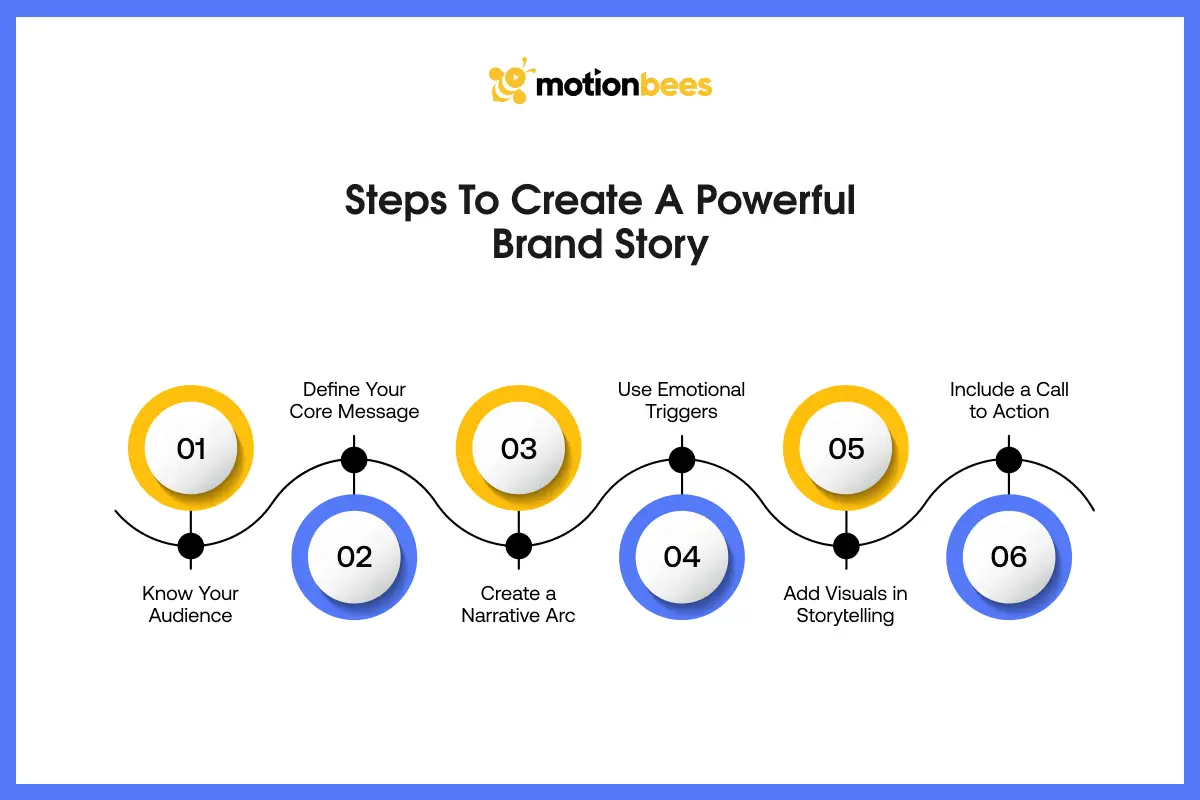
Know Your Audience
The first step that is going to count is finding your target audience. You need to know who they are and almost everything about this. This takes proper research but the results will help you know what makes motives them and what they struggle with. It will also tell you what they expect from you to help you lay out a proper guideline. If you don’t know this, you may end up with a story that won’t serve the right audience. To make a real connection with customers, study what is brand storytelling and how it covers customer behavior, needs, and dreams.
Define Your Core Message
Any story should have a good idea that should guide all the talking. This message demonstrates the importance of the brand and the value it provides. With a brand narrative example, you story is not only looks clear but also consistent on all platforms.
Create a Narrative Arc
Good marketing stories always carry a simple format which has a challenge, a journey and a change. This is the kind of framework that brings out clarity and emotion. If you want your brand stories to have this factor, give solutions to problems that people can relate and use.
Use Emotional Triggers
Emotion attracts attention, retains memory and motivates action. Also, convincing stories inspire hope, trust or the feel of belonging. Such stories stand out more than those have bare facts. All this explains what is brand storytelling has to do with emotions and how it influences the way we feel and make decisions.
Add Visuals in Storytelling
People learn better with images as it enhances memory and learning. This could be in a way of storyboards, animation styles, or social media reels that are discuss ideas in an easy and quick way. Also, the visual content has to be easy to understand. It must not be complex if the goal is to engage but also belong.
1- Include a Call to Action
A good brand story is always going to direct the audience to the next step. It will never leave people hanging but make them explore and engage more. All this often leads to purchases but with a touch of connection. Audience often sit and think, should they explore more, engage, or buy. And that what serves the goal of a strong storytelling, making people relate as well as compel people to take action.
Start creating an effective brand story today!
Examples of Successful Brand Storytelling

Patagonia

The brand excels because it reveals what storytelling feels like in actual life. The brand does not just sell jackets, and it has a clear environmental mission. Their campaigns feature the actual behavior, influence, and l values. Now this is called storytelling with a purpose.
The graphics are not complex yet effective. They used storyboard designs to make the message sounds natural rather than salesy. Patagonia’s creative storytelling creates trust. It gives you a lesson that when your story has a meaning, both your brand and its product will be remembered.
Airbnb

Storytelling at Airbnb is human. It does not brag about their services but focus on telling how they make people lives easy when they are traveling. They tell stories of actual host and traveler which make people belong and connect. All this help audience feel safe in choosing them.
When you see their campaign videos, you see a smooth transition which comes from proper planning in the animation process.
It is their true brand storytelling that make them real and accessible for all. In case you are learning how to write a brand story, Airbnb can teach you that audience want actual experience more than just claims from the brand.
Burberry

They share their brand stories in the form of film with cinematic effects. You can obviously see how their campaigns feel like short movies displaying heritage, craftsmanship, and future outlook.
The brand has a mission and that teaches us on telling your brand story that make audiences experience it on the screen. This creative storytelling makes branding an experience where each frame has emotion. Each frame is properly structured, planned and organized to have that effect.
If you think your brand thrives on memory and visuals, Burberry is the example that can teach you what is brand storytelling. Go to their website, watch their campaigns and see how they are memorable because their powerful visuals.
Nike

Nike narrates the stories of human potential and determination. Its campaigns are based on the stories of athletes, their struggles and their wins, rather than their products. This demonstrates storytelling in the form of inspiration and change. The narrative is never confused, it is always struggle, hard work, success.
Nike tells you that when you start writing a brand story, you focus on emotions and not the product itself. This explains their motive which they believe but also make their audience believe. This is, that people do not just buy performance gears, they buy the faith and inspiration comes from them.
Common Brand Storytelling Mistakes to Avoid

Paying Too Much Attention to the Company
One of the most common errors in marketing storytelling is when brands become the hero itself. You can’t just talk about your value, products, features without your audience feeling it too. Do not brag but make a connect. Put your audience on the spotlight, make stories that can connect with them.
When no effect and just sales pitch, you are not going to excel. Companies that truly understand how to do branding through storytelling are only the ones who can make relatable and emotional connections.
Ignoring Audience Viewpoint
If you are going to ignore the needs and wants of your audience, you won’t be creating a brand story that’s powerful. You must know what motivates them and what they need to create a wonderful story. Otherwise, your brand story is going to be out of place.
Study the real life experiences of the customer. Brands who do not pay attention to their audience, their story means nothing. It is just plain facts or information that won’t get real and fruitful outcomes.
Exaggerating Claims
Big promises hurt trust. The strength of the real brand storytelling depends on sincerity and transparency. When brands take too much or tell unrealistic stories, audience sense it and they become unresponsive.
Know that an effective product story of brand revolves around realistic benefits and realistic results. In knowing what is brand storytelling, the art is expressing actual value without faking it.
Inconsistent Brand Message
Incomplete or false narrative misleads and weakens identity. There has to be consistency in brand storytelling. And by consistency means, the story must be same in videos, designs or texts. Basically, the story about what the brand is and then you will see how it generates recognition, trust and liking for you among audience.
Lacking Emotional Depth
Stories with facts feels weak, they don’t appeal. By adding emotions, you can make them connect, motivate, and recall you. Emotionless storytelling is nothing more than dull messaging.
To have a creative storytelling, brands must generate stories with experiences, challenges, and change, rather than facts.
How to Measure the Impact of Your Brand Story

It is not enough to build a powerful story. You also have to figure out if the story has made an impact or not. The question is, how will you know? Well, there are metrices to measure it. Brands and businesses can find out what works, evokes emotions, or drives action by looking at audience engagement, their conversion, and brand awareness. These three metrices are what brands to score storytelling. Also, there are tools that can help you track and figure out what’s happening.
Engagement Metrics
It is the way audience interact with your work. They will either share, comment or subscribe which will show engagement. You can also see the watch time to find the total amount of interaction.
Stories with maximum engagement trend. It could be a video, a post or a short social media video production reel, you will see it liked and loved by audience.
This way, you can find out the areas that interest audience. Also, who is casually reading the story and who is actually responding to it.
Conversion Metrics
If you find your audience in the ‘Add to Cart’ mentioning their payment details, congratulations! This is conversion which is when a viewer takes an action. Other than buying, conversion is also asking questions, subscribing, buying, or doing downloads, happens after they watched your story.
Effective storytelling is the one that interest viewers and then make them take decisions, yes, buying from you. So, monitoring conversions works wonderfully for companies to study behaviors and what provides actual business outcomes.
Brand Awareness Metrices
This gets your brand recognition and make it memorable. It could be a mention on a story or post, search growth and recall. All this tells brands whether the audience talked about the brand or will recall it in the long run or not.
The best way to increase brand awareness is by being consistent. You need to look, feel and sound the same on all platforms. If you have the ability to tell consistent stories in multiple channels, you will create a lasting presence. You know why? Because awareness grows gradually and when it does, it benefits you for years and years.
Conclusion
Understanding what is brand storytelling is important for every brand and business. It is the only way you are going to connect with your audience for better. You can use other forms of branding and marketing, but you may not last on the list long.
Storytelling is the best way to communicate. If they are true and made with a purpose, it connects with audience on personal more human level.
Always put your audience on the spot, make stories that revolves around them because they are the ones you want to engage with. And that’s how you see more conversions and get better ranking.
Also, be consistent. This is one thing that is going to make your brand credible. Start simple, create stories that are true and your audience will love. Add, purpose, values, and vision in it.
Ready to Share Your Story?
Your brand has a story but don’t know how to make it compel your audience? Contact Motionbees and we will create a compelling brand story for you.
Brand storytelling is the utilization of stories to describe what your brand is, what values it has, and what it represents. It does not only sell things, it communicates with people by demonstrating actual experiences, difficulties and transformations that make your brand memorable.
Stories aid in creating emotional connections, trust, and loyalty. They make your brand to be easier to remember and make decisions. They also make people share and interact, transforming casual customers into fans by demonstrating the purpose of your brand.
Well, you need to go step by step. First, look for your target audience and find out who they, what they like or motivate them. Then, think of a compelling brand story, the one which is going to engage and convert them. Once you have that, you can then add a unique characters and emotions to it according to your audience. This way, your audience will not only like but recall your brand for long.
There are four types and they all are useful depending on which brand it is and what purpose it has. First, there is origin stories that is going to tell people how your brand started, why it started and give customer stories with a touch of real life experiences. Then comes founder stories. They tell people your brand history, also the story behind your products and why they can change lives. Then comes that talks about what the brand hopes to achieve in the future, including brand goals and its social impact. The last one is customer stories involve the real lives of customers and how the brand transforms their lives
Monitor performance based on shares, comments and interactions. Monitor sales, sign-ups and other conversions. Pay attention to the number of mentions of your brand or to the increase or decrease of the search positions. The way people feel, as well as the numbers, is important since a story only works when it causes people to care and take action.

Hafsa Hanif is a talented content writer at Motionbees, Webnhubs and Artisticore specializing in topics such as graphic design, web design and development, logo design, and animation. With her deep understanding of design principles and creative processes, Hafsa crafts engaging, informative, and SEO-optimized content that resonates with readers. Her expertise in SEO ensures that her articles not only captivate audiences but also rank well on search engines, helping businesses boost their online presence through compelling design-focused narratives.
