- What Healthcare Animation Actually Is
- Why Healthcare Animation Works
- Types of Healthcare Animation
- Who Actually Uses Healthcare Animation
- The Healthcare Animation Production Process
- Regulatory and Compliance Considerations
- What Drives the Cost of Healthcare Animation
- The Future of Healthcare Animation
- How to Choose a Healthcare Animation Studio or Partner
- Get Started With Motionbees for Healthcare Animation
Healthcare information can be really hard to understand. You have to read through documents and deal with medical terms that are confusing. Even pictures do not always help.
This is a problem for patients, nurses, and everyone who works in healthcare. When people are confused about healthcare, it can cause problems. They might not get the diagnosis.
Or they might not follow their treatment plan. They might not even trust their healthcare providers. It can also lead to lower engagement.
That is why healthcare animation is a way to fix this problem. It is not about making things look nice. It actually helps people understand medical ideas by turning them into simple stories with pictures.
This is why healthcare providers, pharmaceutical companies, and medical device manufacturers use animation to communicate with people. Teachers use it too. That is why we will talk all about healthcare animation in this blog.
So, without any further ado, let’s get right into it.
What Healthcare Animation Actually Is
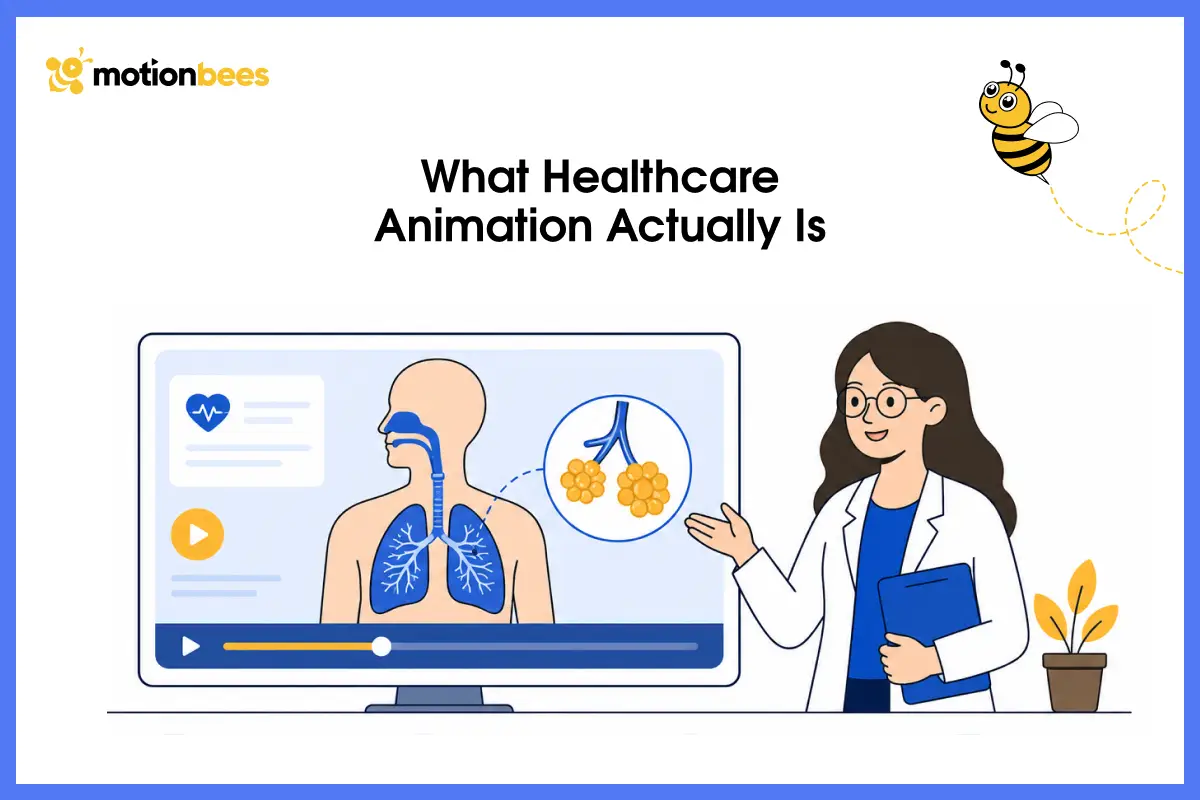
Healthcare animation is when we use types of animation like 2D animation, 3D animation, or motion graphics to explain things like medical treatments and devices.
It also explains medical concepts, procedures, and healthcare processes in an easy way. This helps people understand things that are hard to explain with just words or pictures.
Healthcare animation is different from other types of animation because it has to be correct from a medical standpoint. It must also follow the rules of the healthcare industry.
Doctors, researchers, and healthcare experts look at projects to make sure everything is correct.
Healthcare animation is really cool because it can be a video that explains something or it can be a very detailed 3D simulation of a surgery. These things show us how the human body works.
Ready to Simplify Complex Healthcare Communication?
Create Accurate and Engaging Healthcare Animations With Motionbees!
Why Healthcare Animation Works
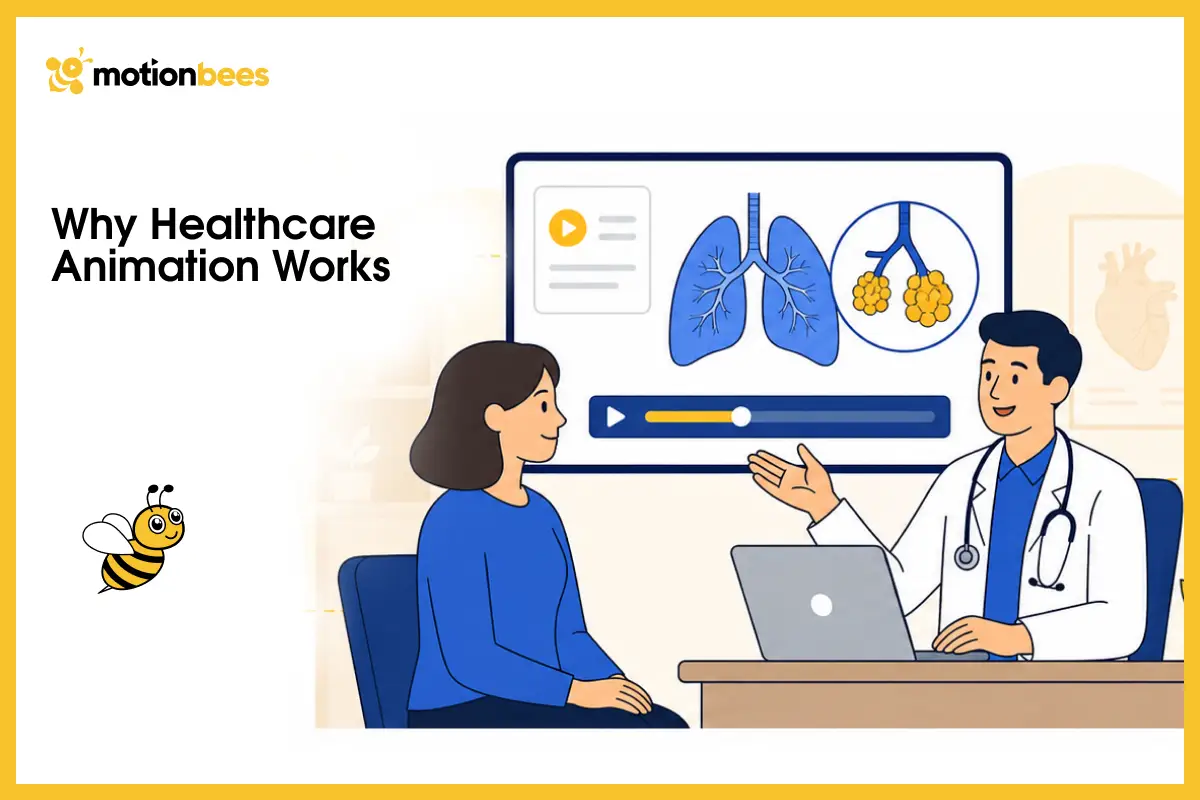
Healthcare animation actually works because people tend to grasp and remember pictures and video stuff more than written words.
It’s pretty good for everyone, especially when medical specialists are trying to get across how our bodies work or how to take the medicine correctly.
With healthcare animations, it makes hard ideas easier to understand. This helps patients feel confident about what is happening with their body and what they need to do in order to get better.
When patients understand what’s going on, they are more likely to follow the doctor’s advice. They can then take an active role in their own healthcare.
For doctors, and for the folks who create medicine and medical devices, animation is also a pretty simple way to show how things work.
A mechanism of action or product demonstration can be understood much faster and remembered longer than a detailed document or data sheet
Types of Healthcare Animation
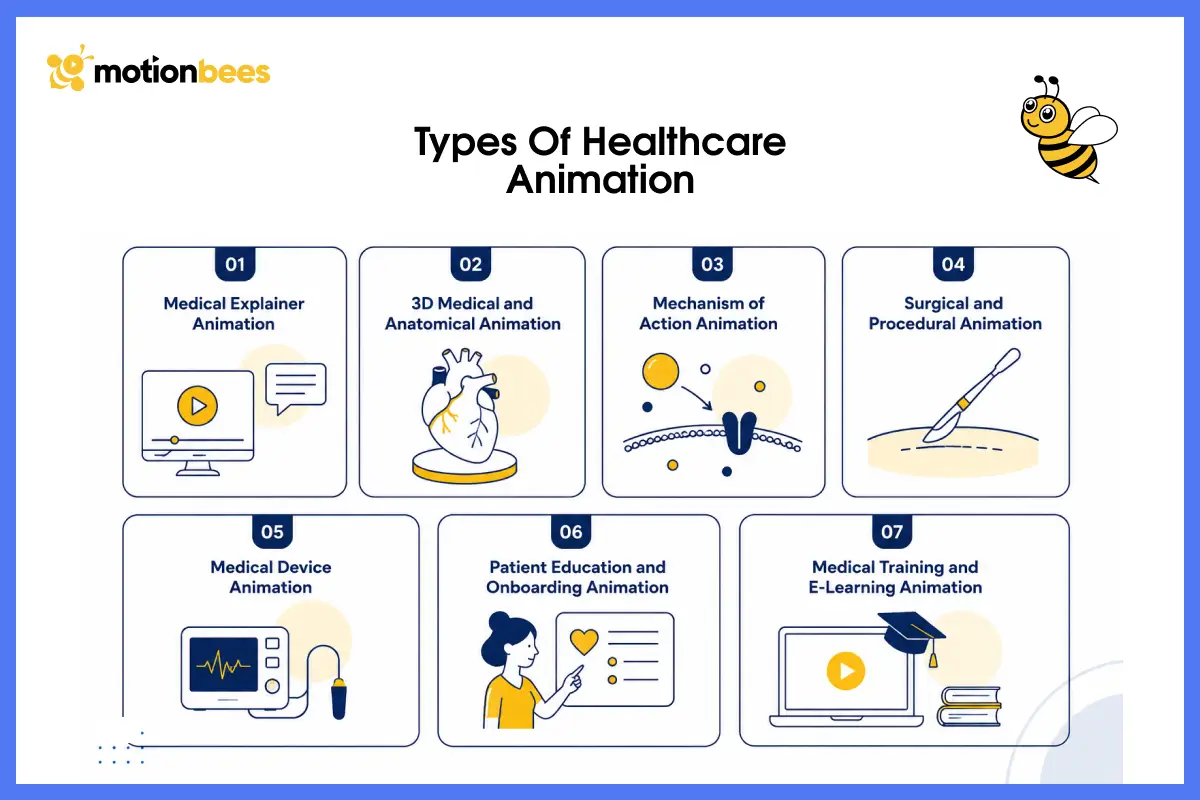
The following are the different types of healthcare animation:
Medical Explainer Animation
Medical explainer animation makes diseases and treatments easier to understand. It uses pictures to explain things like symptoms and healthcare topics.
This helps people who are sick, their families, and everyone else learn about important medical things.
Medical explainer animation does this in a way that is easy to understand. This is so people do not feel confused by big words or long talks about medical things.
3D Medical and Anatomical Animation
3D medical and anatomical animation makes detailed pictures of organs and body systems and how they work.
This helps doctors, nurses. students, and patients see how the human body works and what happens when we get sick.
Mechanism of Action Animation
This animation shows what happens inside our body when we take medicine. It shows what the medicine does at a small level, like inside our cells or with the tiny molecules that make up our body.
Pharmaceutical companies use this animation to help doctors and other people who work in healthcare understand how the medicine works. They also show it to investors and patients. This is so everyone knows what the medicine does.
Surgical and Procedural Animation
Surgical and procedural animation shows procedures one step at a time. It helps patients learn about the treatments they will have. It also helps patients make choices about their care. More so, it trains doctors and other health workers. It also shows ways to do surgery. It also shows tools and machines used in medicine.
Medical Device Animation
Medical device animation shows how a healthcare product works using clear and easy to understand visuals. It helps people learn about the product.
It is useful for training people who use the product. More so, it helps in marketing the product. It can be used in presentations for investors too.
Also, it is used for regulatory submissions. It makes it easier for doctors and nurses to see what the device does.
Patient Education and Onboarding Animation
Patient education and onboarding animation shows people how to go through treatments. It also shows how to attend appointments and how to deal with hospital procedures.
Furthermore, it shows how to use healthcare apps. This animation makes things clearer. It also answers questions that people often have.
More so, it makes patients feel more sure of themselves during their time in the healthcare system.
Medical Training and E-Learning Animation
Medical training and e-learning animation help students and healthcare professionals learn skills using engaging visuals.
It makes it easier to understand difficult topics. It also helps with continuing education by offering learning experiences that are always the same and simple to follow.
Who Actually Uses Healthcare Animation
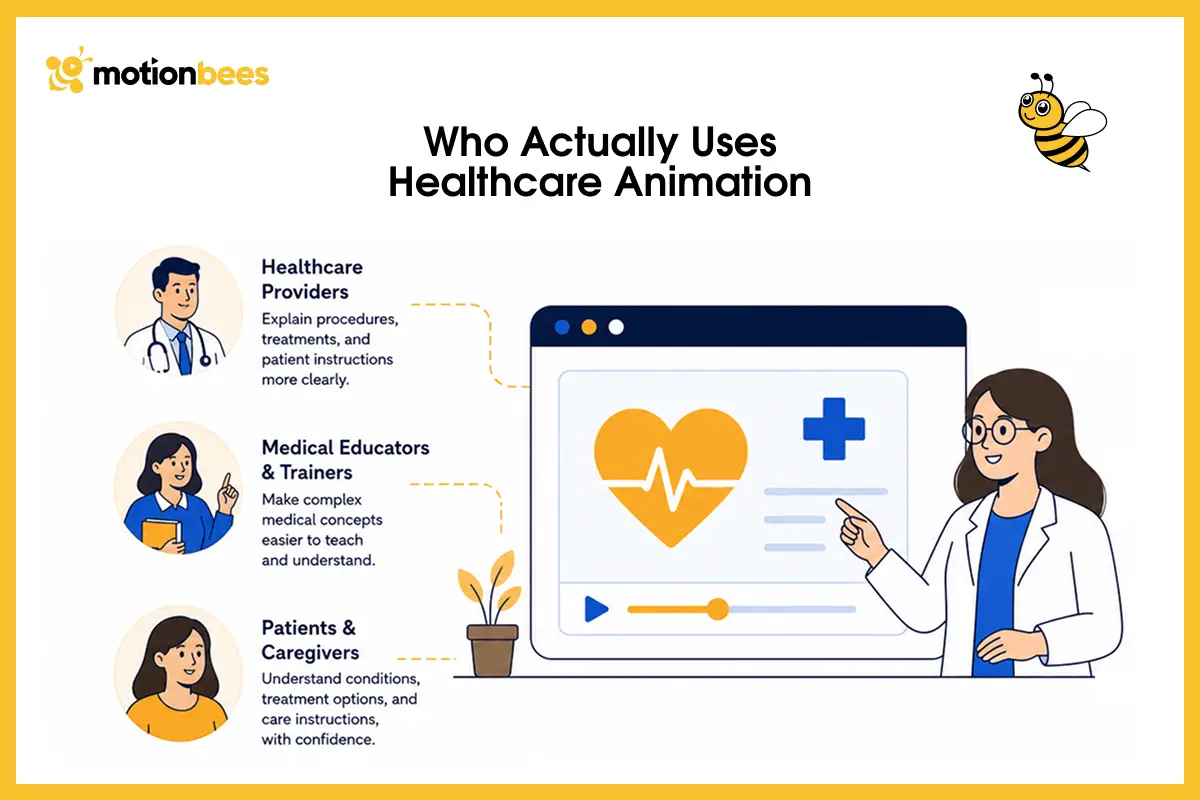
Healthcare animation is used by many organizations across the medical industry. Pharmaceutical firms create mechanism of action videos, sales presentations, and educational content for healthcare pros.
Medical device manufacturers use animation to show how their products work. They also use it to help doctors learn how to use them and get approval from regulators.
Hospitals and clinics use animations to teach patients about their health. They also use it to get their consent for treatments. More so, they use it to train the people who work there.
Medical device manufacturers and health tech companies also use animation to explain how to use apps. They use it to help new users get started and manage health conditions.
Medical schools and training institutions use animation in lessons to make it more interesting and help students learn. Even the people who provide health insurance use animation to explain what is covered.
They also use it to explain how to make a claim and what the benefits are in a way that is easy to understand.
Need Healthcare Animations that Educate and Inspire Confidence?
Partner With Motionbees to Bring Your Medical Concepts to Life.
The Healthcare Animation Production Process
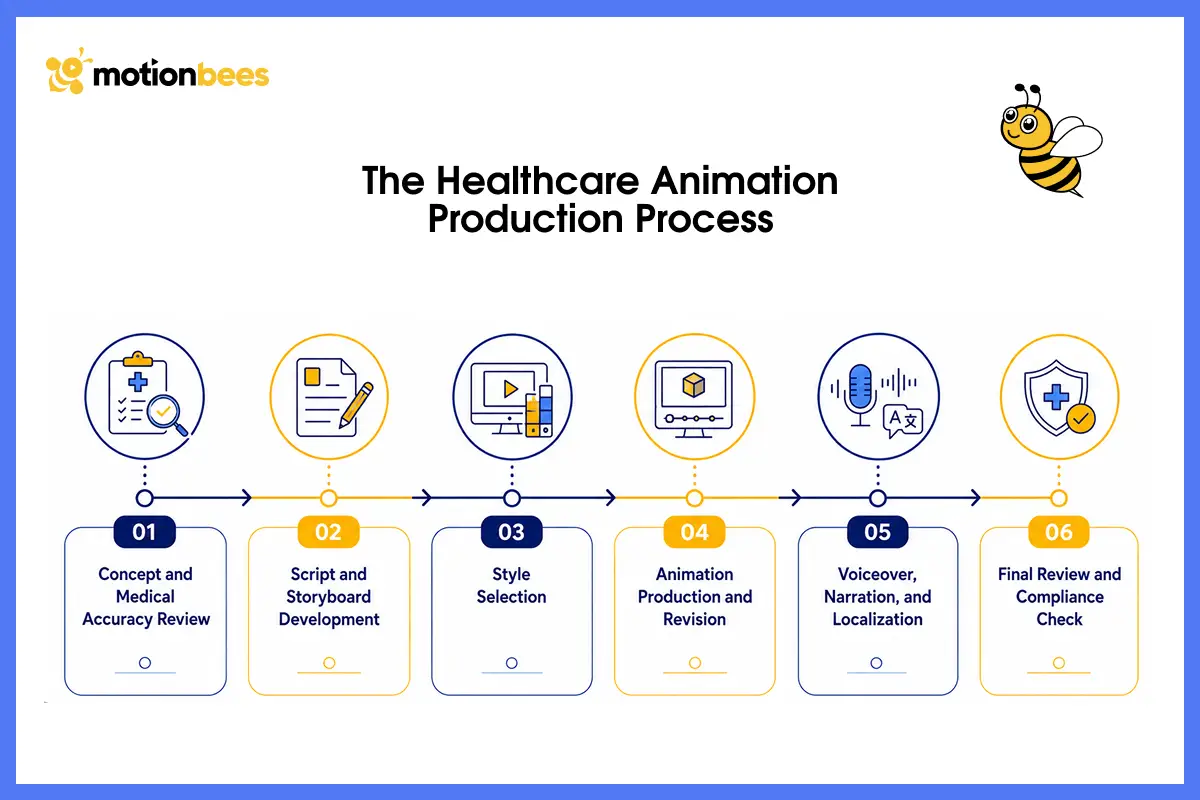
The healthcare animation production process includes the following steps:
Concept and Medical Accuracy Review
Every healthcare animation begins with an idea and a check for medical accuracy. Medical professionals or people who know a lot about the subject often look over the information.
They make sure the content is correct according to science. They also make sure it is something people can trust. More so, they check that it works well for the people who will see it.
Script and Storyboard Development
The script is written in a way that is easy to understand. It explains the message in simple words. The storyboard is like a map.
It shows what will happen in every scene before the animation starts. This is an important step to make sure that the pictures, the story that is being told, and the way it is all put together work well to help people understand medical information.
Style Selection
The animation style depends on who’s watching and what the project is trying to achieve. People on the team pick between 2D animation and 3D animation.
They also decide if the pictures should be realistic or simpler. This helps make the content interesting, correct, and easy to follow.
Animation Production and Revision
Animators take the storyboard. They make it come alive by designing scenes, adding movement and including visual effects.
There are times when clients and medical experts look at the work and give feedback. This helps make sure the final animation is correct, clean, and works well.
Voiceover, Narration, and Localization
Using a voiceover for healthcare animations makes them easier to understand and more interesting to watch.
Doing localization means adapting to the language, terms, and the local culture. This way, the same animation can be used to get a message across to people in parts of the world, and it will still make sense to them.
Final Review and Compliance Check
Before it is released, the animation has to go through a check to make sure it is good and follows all the rules.
The people in charge check the facts, the pictures, the message, and the rules that have to be followed.
They do this to make sure the content is correct. They also ensure the animation follows all the rules. After checking, it is ready for people to see or for professionals to use.
Regulatory and Compliance Considerations

Healthcare animation has to be interesting and fun to watch. It also has to follow a lot of rules. In the United States, people who make animations for medical device companies have to make sure they are doing everything right.
They have to check with the FDA to make sure they are following the rules for promoting medicines and devices.
The information in these animations has to be correct. If it is not, it can cause problems. It can even get people in trouble with the law.
Many projects need to be approved by doctors, lawyers and other experts before they can be shown to people.
This is especially true if the animation includes stories about patients, pictures of patients, or information about people’s health.
In these cases, the people making the animation have to think about HIPAA privacy rules. When healthcare companies follow all these rules, they can build trust with people.
They can also avoid problems and make educational or promotional content that people can rely on.
What Drives the Cost of Healthcare Animation
The cost of healthcare animation depends on a lot of things. One big thing is whether the project uses 2D or 3D animation.
Healthcare animation that uses 3D animation usually takes more time and expertise. This means it can be more expensive.
The length of the healthcare animation video also affects how much it costs. If the healthcare animation video is long or has a lot of scientific details, it will cost more.
Sometimes healthcare animation projects need doctors or experts to review them for accuracy. This can also add to the cost.
Other things that can increase the cost of healthcare animation are voiceovers, translations, and making versions in different languages.
If you understand all these things, you can plan a healthcare animation project that meets your goals and your budget.
The Future of Healthcare Animation
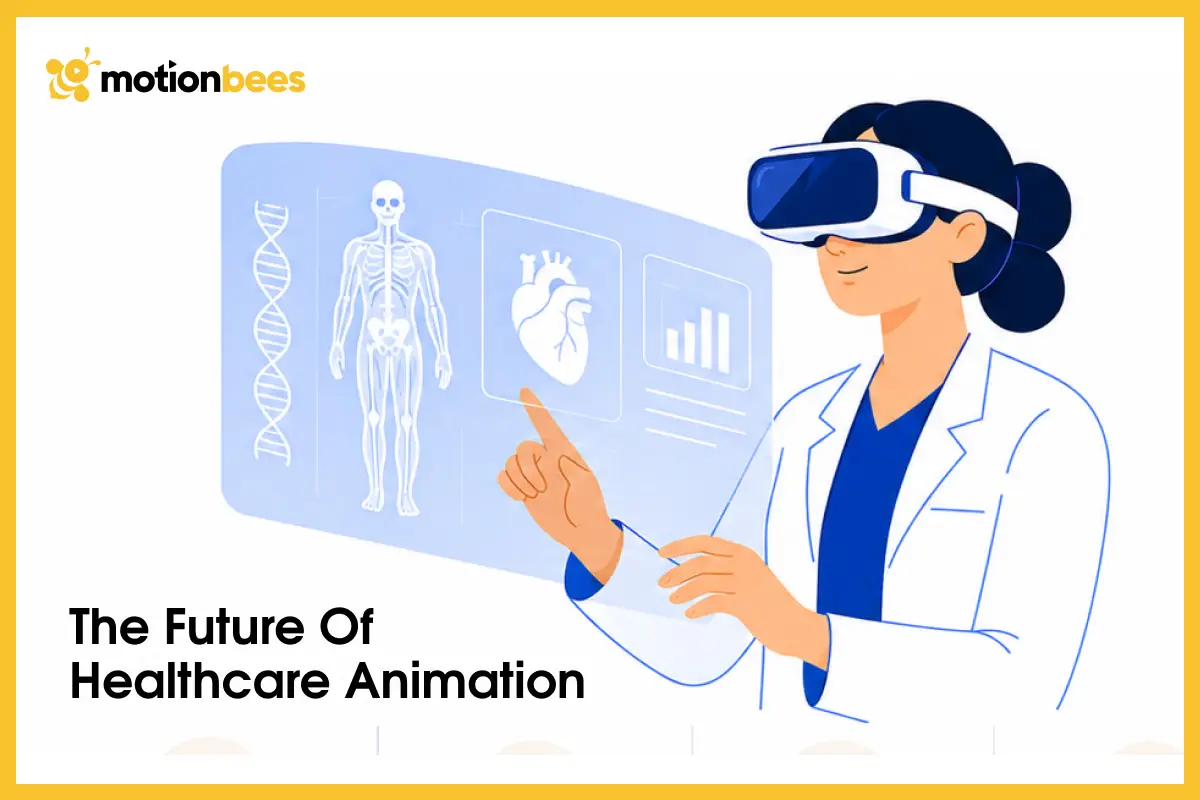
Healthcare animation is getting better and better every year. Now more healthcare organizations are using animations that people can interact with. They are personalized for each patient.
This makes learning about healthcare more interesting for patients. Tools that use AI to help with animation are also assisting teams that create animations.
They help them come up with ideas and drafts more quickly. This saves a lot of time when they are first starting to work on a project.
Telehealth platforms and patient portals are also using animated content to help explain things. This includes treatments, medications, and care plans for patients.
At the same time, people are starting to pay more attention to virtual reality and augmented reality for training surgeons and teaching patients about healthcare.
These technologies are still being developed. But they will be very important in the future.
How to Choose a Healthcare Animation Studio or Partner
Choosing the right healthcare animation studio is about more than creative skills. When you are looking for a team to work on a healthcare project, you should find a team with experience in healthcare, pharmaceutical, or medical projects.
You need to ask the team how they make sure that the information they provide is clinically and scientifically accurate.
You should also ask if they work with doctors or medical experts when they are making the project.
It is also very important to check if the team knows about the rules and regulations that they have to follow.
You have to check if the team understands what they need to do to comply with the rules and if they do a compliance review. Finally, request examples that match your needs.
A studio experienced in patient education may not specialize in mechanism of action videos or medical device animation, so relevant expertise makes a big difference.
Turn Complex Medical Ideas into Clear Visual Stories.
Let Motionbees Create Healthcare Animations that Deliver Real Results.
Get Started With Motionbees for Healthcare Animation
At Motionbees, we make healthcare animations. We provide Healthcare Animation Services to help people understand medical information.
Our animations are clear and easy to understand. We make all types of healthcare animations. Our team is very good at telling stories in a visual way.
More so, we make sure the medical information is accurate. Partner with Motionbees and let us make healthcare animations that teach and deliver real results for you.
Final Thoughts
So, there you have it, folks; that is it for this blog on healthcare animation. As you know, healthcare animation is more than just visuals. It is a communication tool that helps patients, healthcare professionals, and even businesses make sense of complex medical information with a bit more clarity. It helps people understand better. And it can raise engagement too. This is so everything feels less confusing.
More so, it supports learning. All of this allows healthcare animation to lead to stronger patient experiences. It can also lead to better, more effective healthcare communication. The right animation sort of makes a lasting impression. If you are ready to simplify healthcare topics and also connect with your audience in a stronger way, Motionbees is here to help. We will help you build animations that produce real results.
Healthcare animation explains medical concepts and treatments. It also explains devices and procedures. These videos are for patients, professionals, education, marketing, and training purposes.
Costs vary based on animation style. It also depends on video length, complexity, medical accuracy requirements, voiceovers, and localization needs involved.
Not always. But pharmaceutical and medical device animations often require regulatory review before public distribution and promotion.
2D animation is simpler. 3D animation provides detailed and realistic visualizations of anatomy, treatments, and medical procedures.
Most healthcare animation projects take several weeks. But it depends on complexity, revisions, approvals, and production requirements involved.
Yes. Healthcare animation helps educate patients. It also builds trust and increases engagement. It clearly communicates healthcare services and treatments.

Sultan Hanif is a seasoned wordsmith, who brings technology trends and innovations to life through his words. A tech-savvy gamer with a passion for all things football, Sultan blends his technical knowledge with creative storytelling to empower businesses and individuals alike.
